

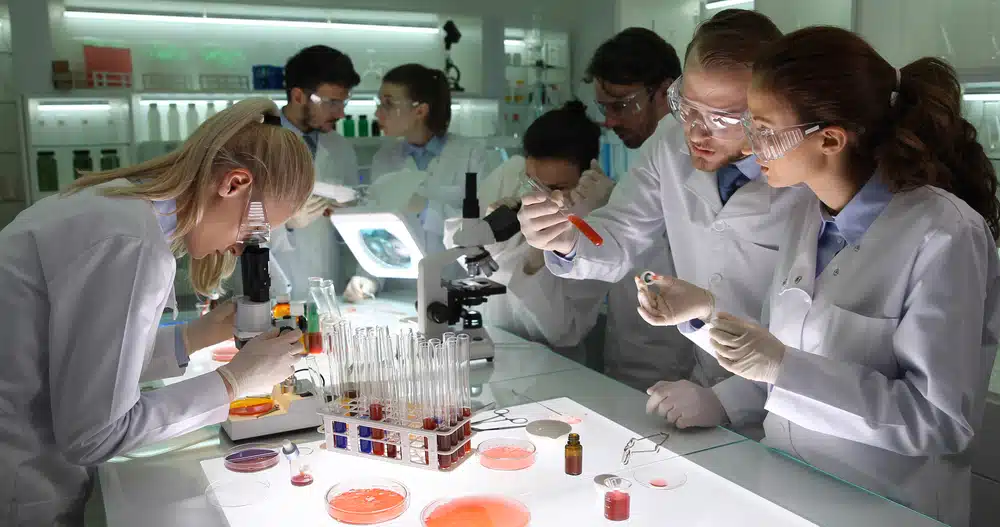
The best biology competitions for high school students are designed to assess scientific understanding, analytical skill, and academic rigor. In events like the USA Biology Olympiad, you are asked to prepare for college-level tests covering topics such as plant physiology, biochemistry, and genetics. While in the Regeneron Science Talent Search, you get to design an original research project and present it to expert reviewers.
These competitions closely mirror the demands of undergraduate research and provide strong evidence of readiness for college, especially if you’re aiming for the best biology schools, like Harvard and MIT. In this blog, we’ve come up with a list of the top biology competitions, explaining how each one works, who it’s best suited for, and what kind of experience you can expect from participating.
- Best Biology Competitions for High School Students
- USA Biology Olympiad (USABO)
- Regeneron International Science and Engineering Fair (ISEF)
- Regeneron Science Talent Search (STS)
- National Science Bowl
- BioGENEius Challenge
- Davidson Fellows Scholarship
- Junior Science and Humanities Symposium (JSHS)
- Science Olympiad
- International Brain Bee
- Genes in Space Challenge
- American Society of Human Genetics DNA Day Essay Contest
- AAN Neuroscience Research Prize
- Frequently Asked Questions
- Takeaways
Best Biology Competitions for High School Students
Biology competitions assess your knowledge and skills in the field, whether it’s through an exam format that tests your objective knowledge and recall skills or through the presentation of original projects that showcase your initiative and analytical thinking. Many of these competitions reward depth and originality, offering scholarships, mentorship, and recognition from universities and research institutions.
In fact, some impactful ideas began this way: Jack Andraka’s early work on a low-cost method for pancreatic cancer detection started as a student project. It was then presented at the Regeneron International Science and Engineering Fair, where it won and eventually influenced diagnostic research.
Below is a table highlighting some of the best biology competitions for high school students, including where they’re held and their typical timelines.
| Rank | Biology Competition | Location | Dates |
| 1 | USA Biology Olympiad (USABO) | Nationwide (schools & test centers) | February 4, 2026 (Online open exam) | June 21 – July 2, 2026 (National finals) |
| 2 | Regeneron International Science and Engineering Fair (ISEF) | Varies yearly (U.S.-hosted) | May 2026 |
| 3 | Regeneron Science Talent Search (STS) | Online; Finals in Washington, D.C. | Nov 2026 (application deadline); Jan 2027 (Top 300 & Top 40 announced); Mar 2027 (Finals Week) |
| 4 | National Science Bowl | Regional sites; Washington, D.C. (Finals) | Jan–Mar 2026 (Regionals); April 30 – May 4, 2026 (National finals) |
| 5 | BioGENEius Challenge | New York City (National Finals) | Fall 2026 (National Finals & BioFuture Conference) |
| 6 | Davidson Fellows Scholarship | United States | February 11, 2026 (application deadline); May 8, 2026 (decisions are emailed) |
| 7 | Junior Science and Humanities Symposium (JSHS) | Regional; National Symposium (U.S.) | Winter–Early Spring (currently on hold) |
| 8 | Science Olympiad | University of Southern California (2026) | May 22–23, 2026 (National Tournament) |
| 9 | International Brain Bee | Varies by country and region | Varies by chapter |
| 10 | Genes in Space Challenge | United States; ISS (winning experiment) | January 5, 2026 (contest opens); July 2026 (winners announced) |
| 11 | American Society of Human Genetics (ASHG) DNA Day Essay Contest | Worldwide (online via schools) | March 2026 (submission deadline) |
| 12 | AAN Neuroscience Research Prize | United States (remote submission) | Late Summer–Fall 2026 |
Let’s discuss these competitions one by one.
1. USA Biology Olympiad (USABO)
- Dates: February 4, 2026 (Online open exam) | June 21 – July 2, 2026 (National finals)
- Location: Nationwide (hosted through registered high schools and authorized test centers in the U.S.)
- Prizes: Gold, silver, bronze medals, and inclusion in the USA’s national team
The USA Biology Olympiad is a biology competition for high school students in a timed examination format. The Open Exam, the first round of the series, is an online multiple-choice exam; later rounds add multiple true/false and short-answer questions. If you advance, you move closer to national-level exams modeled after international standards and even get the chance to represent the country in the International Biology Olympiad.
The entire series will cover seven focus areas: cell biology, genetics and evolution, ecology, plant and animal physiology (including neurobiology), ethology, and biosystematics. Once your school registers, you get access to the Teacher Resource Center, which includes curated materials aligned with International Biology Olympiad focus areas.
You’re eligible if you’re in grades 9–12, a U.S. citizen or permanent resident, and not yet enrolled in college. Homeschoolers can participate through local schools. While there’s no cash prize, USABO’s real value lies in its prestige; strong performance often indicates serious academic readiness to enter top STEM programs and selective colleges.
We broke down how the USABO works and what you need to advance.
2. Regeneron International Science and Engineering Fair (ISEF)
- Dates: May 2026
- Location: Varies yearly; hosted in the U.S.
- Prizes: (1st Award) $6,000 | (2nd Award) $2,400 | (3rd Award) $1,200 | (4th Award) $600 | Additional special awards and sponsored prizes
Regeneron ISEF, described as the “Olympics of science fairs,” is the world’s largest and most competitive science research competition for high school students. Rather than applying directly, you need to qualify by winning or placing at an affiliated local, regional, or national fair. At ISEF, you can expect to present your poster and defend your work before PhD scientists, engineers, and industry researchers.

The competition boasts a prize pool of nearly $9 million, comprising awards, prizes, and scholarships. Winners of the 1st Award category can win even more prestigious awards—such as the Regeneron Young Scientist Award and the EU Contest for Young Scientists Award.
You’re eligible if you’re enrolled in grades 9–12 (or equivalent), are under 20 years old on the competition date, and have not begun postsecondary studies. Projects may be individual or team-based, but teams are limited to two students. All projects must comply with Society for Science research rules, including approvals for human or animal subjects when applicable.
Check out our complete Regeneron ISEF guide to learn more about it.
3. Regeneron Science Talent Search (STS)
- Dates: Nov 2026 (application deadline); Jan 2027 (Top 300 & Top 40 announced); Mar 2027 (Finals Week)
- Location: United States (final judging held in Washington, D.C.)
- Prizes: (Top award) $250,000 | (Top 40 finalists) at least $25,000 each | over $3 million awarded annually in scholarships and prizes
The Regeneron Science Talent Search requires you to submit a full research portfolio, including an original independent research paper, essays, recommendations, and documentation of your work. Projects span biology, chemistry, computer science, engineering, medicine, and more, but strong biology entries often involve experimental, computational, or data-driven research.
The competition begins with a holistic review of thousands of applications. The top 300 scholars are named first, followed by the Top 40 finalists, who are invited to Washington, D.C. to present and defend their research before panels of expert scientists. Finalists are evaluated on scientific rigor, originality, depth of understanding, and communication skills.
You’re eligible if you’re a U.S. high school senior. STS stands out because it rewards long-term, independent research and clear scientific thinking, making it especially influential for students aiming for top STEM programs, MD/PhD paths, or research-driven careers.
We explain more in our Regeneron STS blog about what you can expect and how to get into the competition.
4. National Science Bowl (NSB)
- Dates: April 30 – May 4, 2026 (National finals)
- Location: Regional sites nationwide; National Finals in Washington, D.C.
- Prizes: All-expense-paid trip to the National Finals for regional winners’; trophies and medals for top national teams
The National Science Bowl is a team-based competition run by the U.S. Department of Energy. You compete as part of a five-person team—comprised of four active players and one alternate—plus a coach. You’ll face off against other teams in buzzer-style rounds, answering rapid-fire questions in biology, chemistry, physics, Earth and space science, energy, and math.
To qualify, your team must register through a regional coordinator and compete in a regional tournament. Only regional winners advance to the National Finals. You’re eligible if you’re a middle or high school student enrolled in a U.S. school, with teams formed and registered in the fall. While there’s no cash prize, the experience ofcompeting at a national level, representing your region, and proving you can perform under pressure in a team science environment can still set you apart from other college applicants.
5. BioGENEius Challenge
- Dates: Fall 2026 (National Finals & BioFuture Conference)
- Location: CURE Innovation Campus, New York City (National Finals)
- Prizes: ~$10,000 and advancement to national competition (regional winners) | cash awards up to $30,000 (•top national and international winners)
The BioGENEius Challenge is a biotechnology-focused research competition for high school students who are already doing original lab or computational work. Projects are grouped into themed tracks, including medical biotechnology, sustainability and agriculture, and industrial or environmental biotechnology. You will be given the freedom to choose the track you want to join.

You will first compete at the state or regional level. The top projects will then advance to the national stage at the BioFuture Conference, where you’ll present your research to judges from industry and academia.
Strong entries usually involve advanced techniques such as molecular biology, CRISPR applications, or bioengineering methods. For example, the 2024 national winner developed a compact gene switch to precisely control the timing of CRISPR gene editing, addressing a major challenge in improving the safety and precision of gene therapies.
We outline the entire BioGENEius Challenge process, so you know what to expect.
6. Davidson Fellows Scholarship
- Dates: February 11, 2026 (application deadline) | May 8, 2026 (decisions are emailed)
- Location: United States (national competition)
- Prizes: (Fellow Laureates) $100,000 scholarships | (Davidson Fellows) $50,000 or $25,000 scholarships
The Davidson Fellows Scholarship is an academic competition that requires you to submit a significant, original body of work—which can be a full scientific research project, an original literary piece or critical analysis, or a publication-level review of a STEM study. Submissions span nine categories, including Science, Technology, Engineering, Mathematics, Literature, and Music.
The application has two stages. First, you submit a brief project description to confirm eligibility. If approved, you move on to the full application, where you submit detailed materials and recommendations from nominators who can speak to the scope and rigor of your work. Projects can be submitted individually or as a two-person team.
You’re eligible if you’re 18 or younger and a U.S. citizen or permanent resident living in the U.S. (or stationed overseas with the U.S. military). There’s no minimum age requirement.
7. Junior Science and Humanities Symposium (JSHS)
- Dates: Temporarily suspended until further notice, but Regional Symposia are typically held in winter–early spring
- Location: Regional competitions nationwide; National Symposium (in person, all-expenses paid)
- Prizes: (Regional) $2,000 – $1000 undergraduate scholarship | (National) $12,000 – $4000 undergraduate scholarship
The Junior Science and Humanities Symposium is a free, individual research competition open to high school students who have completed original, independent STEM research. It is notably sponsored by the U.S. Department of Defense.
You begin by submitting a written research report to your assigned regional symposium. Then, top submissions advance to a Regional Symposium, where you present your work to expert judges. The top five students from each region move on to the National Symposium.
At Nationals, the top two presenters in each category compete in oral presentations for undergraduate scholarships, while third through fifth place finalists present posters for cash awards. The National Symposium is traditionally an in-person, all-expenses-paid event.
You’re eligible if you’re in grades 9–12 and are a U.S. citizen or legal permanent resident.
The program and official website are currently suspended until further notice, but you can still take a look at our complete guide to the JSHS if you’d like to learn more about it.
8. Science Olympiad
- Dates: May 22–23, 2026 (National Tournament)
- Location: University of Southern California (USC), Los Angeles, California
- Prizes: (Science Olympiad Founders’ Scholarships) Five $10,000 college scholarships for Division C seniors | (Spirit Awards) $2,000 program grants for one Division B and one Division C team
The Science Olympiad is one of the largest and most established team-based STEM competitions in the U.S., built around problem-solving and academic depth. You compete as part of a school team, preparing all year for a slate of events that span biology, chemistry, physics, engineering, earth science, and math. Events range from written exams to lab-style challenges and build-and-test engineering tasks.

Teams qualify for the National Tournament by advancing through regional and state competitions. In 2026, only about 120 of the top teams nationwide will compete at USC, making Nationals a major achievement on its own. Beyond medals, the Science Olympiad offers meaningful scholarships for seniors, recognition for teamwork and sportsmanship, and strong preparation for STEM majors.
We outline the entire Science Olympiad process so you know what to expect and how to prepare.
9. International Brain Bee
- Dates: Varies by country and region
- Location: Varies by location
- Prizes: Advancement to National and World Championship levels; national and international recognition; awards and prizes vary by country and host institution
The International Brain Bee is a three-tiered neuroscience-focused competition where you begin at a local Brain Bee, usually hosted by a university or research institution. Local winners advance to their country’s National Brain Bee, and each national competition sends one representative to the International Brain Bee World Championship.
The competition format varies by location but typically includes written exams, short-answer questions, and oral rounds that cover topics like neuroanatomy, neurophysiology, brain disorders, and cognition. Some levels also include case-based or image-based questions, requiring you to apply concepts rather than just recall memorized facts. Preparation often involves college-level neuroscience textbooks and structured study guides.
Brain Bee is generally open to high school students between the ages of 13 and 19, though eligibility rules can differ by country and chapter. If you’re considering neuroscience, medicine, or psychology, the Brain Bee offers a focused, content-heavy way to test your knowledge and gain early exposure to an advanced field without needing lab access or a research project.
Check our complete guide to the International Brain Bee to know more about the event.
10. Genes in Space Challenge
- Dates: Contest opens January 5, 2026 and winners are announce in July 2026
- Location: United States
- Prizes: Winning experiment launched to the ISS; 5 Finalist Awards; 5 Junior Scientist Awards; 5 Constellation Awards; 10 Honorable Mentions
Genes in Space is a biotechnology design competition where you design a molecular or genetic experiment that could be performed in microgravity aboard the International Space Station. You work individually or in pairs, with guidance from an adult sponsor such as a teacher, parent, or mentor.
Using the official Genes in Space Toolkit—equipment already available to astronauts—you explain how your experiment would test gene expression, DNA damage, microbial behavior, or other space-relevant biology questions. Judges evaluate clarity, scientific reasoning, feasibility, and relevance to space research.
You’re eligible if you’re a U.S. student in grades 7–12. Genes in Space stands out for rewarding scientific thinking and creativity, and the top project is actually sent to space.
11. American Society of Human Genetics (ASHG) DNA Day Essay Contest
- Dates: Submissions usually close around March
- Location: Worldwide (online submission through schools)
- Prizes: National and international recognition from ASHG; certificates and featured recognition for top essays; awards vary by placement and region
The ASHG DNA Day Essay Contest is a writing-based competition where you respond to a specific annual prompt focused on genetics, ethics, and real-world applications of modern biology and craft a well-reasoned scientific essay.
In 2025, the first-place winner examined how artificial intelligence (AI) could be used to interpret genetic testing results, discussing both the potential benefits and the risks of integrating AI into healthcare decision-making. For 2026, the question centers on recent gene therapies such as treatments for sickle cell disease or hemophilia, asking you to explain how the therapy works, weigh its benefits and drawbacks, and reflect on whether you would choose it in a real-life scenario.

Your essay must present a clear, well-supported argument grounded in accurate science. Judges score submissions on scientific accuracy, use of evidence, focus on the prompt, writing quality, and references. Essays go through three rounds of review by members of the American Society of Human Genetics.
Students in grades 9-12 from anywhere in the world are eligible to join. Essays must be written in English and be no more than 750 words. Submissions are sent in by a teacher or administrator (or a parent if you’re homeschooled).
12. AAN Neuroscience Research Prize
- Dates: application typically opens in late summer and closes in fall
- Location: United States (remote submission)
- Prizes: $1,000 and certificates
The AAN Neuroscience Research Prize, sponsored by the American Academy of Neurology, is a competition that requires the submission of an individual research focused on the brain and nervous system. Your project must be original and entirely your own written work, but it doesn’t have to come from a traditional lab setting.
You’re eligible if you’re a high school student in grades 9–12 enrolled in secondary school in the U.S., regardless of age. Projects should focus on neuroscience topics like anatomy, neurophysiology, pathology, or brain function, and must be submitted individually (no team entries). Applications include a research report, a maximum 300-word abstract, a bibliography, and signatures from a parent/guardian, teacher, and mentor.
In 2025, one of the Neuroscience Research Prize winners conducted innovative research into how astrocytes influence the blood-brain barrier and Alzheimer’s disease vulnerability, earning national recognition and a platform to present at the AAN Annual Meeting.
Frequently Asked Questions
1. What are the most prestigious biology competitions for high school students?
Some of the most respected biology competitions for high school students include Regeneron Science Talent Search (STS), Regeneron International Science and Engineering Fair (ISEF), USA Biology Olympiad (USABO), BioGENEius Challenge, and the Junior Science and Humanities Symposium (JSHS). These stand out for their rigor, national or international reach, and recognition by selective colleges.
2. Do colleges actually care about these competitions?
Yes. Colleges value these competitions when they show depth, originality, and long-term commitment to biology. Winning would definitely help you stand out, however admissions officers also focus on what you worked on, how advanced it was, and how clearly you understand your work.
3. Do I need prior research or lab experience to compete?
Not always. Research-based competitions require original work, but exam-based contests, essay competitions, and design challenges often don’t require lab access. Many students start with content-heavy or writing-focused competitions before moving into full research.
4. How do I choose the right biology competition for me?
Start with what you enjoy and what resources you have. If you like exams, choose Olympiads. If you enjoy writing or ethics, look at essay contests. If you have access to research support, then research fairs may be a better fit.
Takeaways
- Biology competitions help you develop core scientific skills such as research design, data analysis, and clear scientific communication—abilities that carry over directly into college coursework and research.
- Top competitions like the USA Biology Olympiad, Regeneron Science Talent Search, and Regeneron ISEF are among the most respected biology competitions for high school students and provide strong academic recognition.
- Choosing competitions that match your interests, strengths, and available resources allows you to produce deeper, higher-quality work and get more out of the experience.
- If you want help selecting the right competitions or strengthening your research, essays, or presentations, working with a college admissions advisor can provide personalized guidance and structure.










