There’s no fiery Duke vs. Yale rivalry, nothing like Duke vs. UNC on the court or Yale vs. Harvard on the football field. But if you’re aiming for a top-tier college, chances are both Duke and Yale are on your list. Yale brings the Ivy League prestige, while Duke holds its own among the nation’s elite. They’re different in vibe, but equally respected, which is why they’re often compared.
In this blog, we’ll break down what sets them apart—academics, campus life, cost, admissions, and more—to help you figure out which one fits you best.
- Duke vs Yale: Quick Overview
- Duke vs. Yale: Acceptance Rates
- Duke vs. Yale: Rankings
- Duke vs. Yale: Admission Requirements
- Duke vs. Yale: Cost of Attendance
- Duke vs. Yale: Financial Aid and Scholarships
- Final Verdict: Duke vs. Yale
- Frequently Asked Questions
- Takeaways
Duke vs Yale: Quick Overview
When it comes to prestige and academics, Duke vs. Yale is a comparison that pops up a lot—especially for students aiming for top-tier schools. Yale has that classic Ivy League reputation—historic, traditional, and deeply rooted in the liberal arts.
Duke, on the other hand, feels a bit more dynamic and modern, with a strong emphasis on research, innovation, and school spirit (especially when basketball season hits).
Before we discuss what sets them apart today, it helps to consider how each school got its start:
Duke University
Duke’s journey started back in 1838 as a schoolhouse in Randolph County, North Carolina, originally called Brown’s Schoolhouse. It later became Trinity College and found its new home in Durham in 1892, largely thanks to the support of the Duke family, especially Washington Duke, who made his fortune in tobacco and energy. Fast forward to 1924, and his son James B. Duke created The Duke Endowment, which led to the school being renamed Duke University in his honor.
From those early roots, Duke has grown into a global academic powerhouse. It’s especially known for top-tier programs in law, business, public policy, engineering, and medicine. Duke Law is consistently ranked among the best in the country, with graduates who’ve gone on to become federal judges, political figures, CEOs, and yes, even a U.S. President (Richard Nixon, Class of 1937).

The Fuqua School of Business has built a global reputation, and has attracted future leaders in finance, tech, and entrepreneurship. On the healthcare front, Duke’s Schools of Medicine and Nursing are deeply respected and closely connected to the world-class Duke Health system.
And then there’s the sports culture—something you can’t leave out when talking about Duke. The men’s basketball program, led for decades by the legendary Coach K, turned the Blue Devils into a household name. The Cameron Indoor Stadium is hallowed ground for college basketball fans, and the Cameron Crazies are a tradition all their own.
Yale University
Yale’s story goes all the way back to 1701, making it one of the oldest institutions of higher learning in the United States. It began as the Collegiate School in Killingworth, Connecticut, founded by a group of clergymen who wanted to train future ministers.
In 1718, the school moved to New Haven and became Yale College, named after Elihu Yale, a British merchant who donated books, goods, and a generous sum of money that helped the school gain traction.
Since then, Yale has grown far beyond its religious beginnings and has become one of the most prestigious universities in the world. It’s home to top-ranked graduate schools, with Yale Law School often leading the pack.
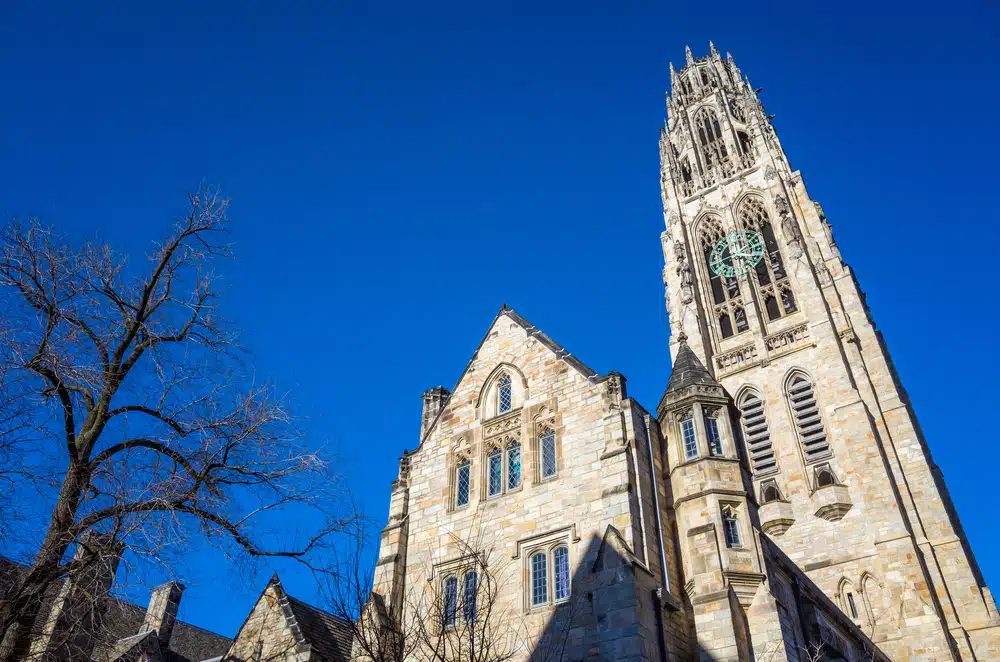
Yale’s alumni include U.S. Presidents like Bill Clinton and Gerald Ford, and a long list of Supreme Court Justices—Sonia Sotomayor, Clarence Thomas, Samuel Alito, and Brett Kavanaugh among them.
But law and politics are just one part of Yale’s legacy. The Yale School of the Environment is a pioneer in sustainability and one of the oldest programs of its kind globally.
In the arts, Yale has made an enormous impact. The David Geffen School of Drama (formerly the Yale School of Drama) has trained icons like Meryl Streep, Lupita Nyong’o, and Angela Bassett. Its Yale Repertory Theatre regularly launches productions that move on to Broadway or collect major awards.
Duke vs. Yale: Acceptance Rates
Each year, Duke and Yale receive tens of thousands of applications from high-achieving students across the globe—and only a small percentage get in. If you’re curious about how competitive they really are, here’s a quick look at their acceptance rates for the Class of 2028:
| School | Acceptance Rate |
| Duke | 5.1% |
| Yale | 3.7% |
For the Class of 2028, Duke accepted just 2,790 students out of more than 54,000 applicants—an acceptance rate of 5.1%. Yale was even more selective, admitting only 2,146 out of 57,465 applicants, bringing its acceptance rate down to a razor-thin 3.7%.
Both schools are incredibly competitive, but Yale is especially tough to get into. Still, earning a spot at Duke is no walk in the park either.
Duke vs. Yale: Rankings
If you’re choosing between Duke and Yale, checking out university rankings can give you a strong starting point. Rankings don’t tell the full story, but they do offer insight into academic reputation, research strength, and post-grad outcomes.
Here’s a quick look at how Duke and Yale have compared over the past few years in three major rankings: Times Higher Education, QS World University Rankings, and U.S. News & World Report.
| World Rankings | Duke | Yale |
| Times Higher Education 2025 | #27 | #10 |
| Times Higher Education 2024 | #26 | #10 |
| Times Higher Education 2023 | #25 | #9 |
| QS World University Rankings 2025 | #61 | #23 |
| QS World University Rankings 2024 | #57 | #16 |
| QS World University Rankings 2023 | #61 | #18 |
| US News Best National University Rankings 2025 | #6 | #5 |
| US News Best National University Rankings 2024 | #6 | #4 |
| US News Best National University Rankings 2023 | #7 | #5 |
Let’s start with the Times Higher Education rankings. Yale consistently lands in the top 10 worldwide, holding strong at #10 in both 2025 and 2024, and #9 in 2023. Duke, while still highly respected, came in lower—ranking #27 in 2025, #26 in 2024, and #25 in 2023.
The QS World University Rankings paint a similar picture. Yale has remained firmly in the top 25, ranking #23 in 2025, #16 in 2024, and #18 in 2023. Duke placed lower here, coming in at #61 for both 2025 and 2023, and slightly better at #57 in 2024.
When it comes to U.S. News Best National University Rankings, the gap between them is much smaller. Yale consistently lands in the top 5 nationally, ranking #5 in 2025 and 2023, and even climbing to #4 in 2024. Duke is right behind, holding steady at #6 in both 2025 and 2024, and #7 in 2023.
So what does this tell you? Yale tends to have a stronger international presence across major global rankings, while Duke performs incredibly well in U.S.-focused lists, often just a step behind the Ivies.
Each ranking system looks at different factors. Times Higher Education weighs research influence, teaching quality, and global reach. QS focuses more on academic reputation and employer views. U.S. News leans into stats like graduation rates, faculty strength, and outcomes for students.
At the end of the day, both are world-class universities. Your pick might come down to what kind of experience you want, globally driven and Ivy-traditional at Yale, or innovative, spirited, and research-forward at Duke.
Duke vs. Yale: Admission Requirements
Let’s take a closer look at what it takes to get into Duke and Yale. While both schools are extremely selective, they each have their own approach to admissions and tend to look for different qualities in the students they admit.
| Application Requirement | Duke Requirements | Yale Requirements |
| Application Platforms | Common Application
Coalition Application QuestBridge |
Common Application
Coalition Application QuestBridge Application |
| Application Fee | $95 (fee waiver available) | $80 (fee waiver available) |
| Standardized Tests | Test-optional (doesn’t require SAT or ACT scores but students can submit)
Average test scores: SAT: 1520-1570 ACT: 34–36 |
Test-flexible (can submit SAT, ACT, IB, or AP)
Average test scores: |
| High School Coursework Recommendations | 4 years of English
3 years of math 3 years of science 3 years of a foreign language 3 years of social studies 2 years of history |
Yale doesn’t list exact years, but they are looking for a strong mix of the following courses:
English Math Science Social Studies Foreign Language |
| GPA | No minimum GPA
Average GPA: 3.9 (weighted) |
No minimum requirements
Average GPA: 3.9 |
| Letters of Recommendation | 3 recommendations required:
2 teacher recommendation letters 1 counselor letter (included in the School Report + optional recommendation letter from an employer, mentor or anyone who speak about you |
3 recommendations required:
2 teacher recommendations 1 counselor recommendation |
| Supplemental Essays | The Common App for Duke includes a personal essay plus 6 Duke-specific short answer questions where you are required to answer 3. | 3 short answers for Yale-specific questions and one essay |
| Application Deadlines | Early Decision deadline: November 4
Regular Decision deadline: January 2 |
Single-Choice Early Action: November 1
Regular Decision: January 2 |
If you’re applying to Duke or Yale, know that strong grades alone won’t be enough. Both schools are incredibly selective and want to see the full picture, your personality, your passions, and how you turn ideas into action. That means thoughtful essays, a solid academic foundation, and a clear sense of what drives you.
Yale is test-flexible, so you can submit SAT, ACT, AP, or IB scores but you’re not required to. If you do send them in, most admitted students score between 1480 and 1580 on the SAT or between 31 and 36 on the ACT.
Yale is big on intellectual depth, service, and meaningful leadership. If you’ve been part of a program like Yale Young Global Scholars or organized a disaster relief drive in your community, that’s the kind of impact they notice.
Duke, on the other hand, is test-optional and typically sees scores between 1520 to 1570 (SAT) or 34 to 36 (ACT) for admitted students.
Duke looks for academic excellence, but they also want students who are driven, engaged, and not afraid to take initiative. Programs like Duke TIP, the LEAD Summer Business Institute, or starting a club focused on healthcare or international issues? Those show exactly the kind of leadership and curiosity Duke values.
If you’re ready to build an application that reflects what these schools are really looking for, we’ve got you. Check out these step-by-step guides to help you craft a standout application:
Duke vs. Yale: Cost of Attendance
Choosing between Duke and Yale comes with a serious price tag, but both schools also offer generous financial aid that can make a huge difference. If cost is on your mind, know that both are committed to meeting 100% of demonstrated financial need—so what you actually pay might be a lot less than the sticker price.
Here’s a quick snapshot of the estimated costs for the 2024–2025 academic year:
| School | Tuition and Fees | Living Costs | Total |
| Duke | Tuition: $56,550
Fees: $2,907 |
Housing: $10,910
Food: $10,075 Books: $536 Miscellaneous expenses: $3,274 Transportation: $1,317 |
$85,579 |
| Yale | Tuition and fees: $67,250 | Housing: $11,300
Food: $8,600 Books: $8,600 Miscellaneous: $1,000 Personal: $2,700 Student activities fee: $125 |
$95,225 |
Those numbers might look intimidating at first, but the good news is both Duke and Yale offer strong need-based financial aid and promise to cover 100% of demonstrated financial need. That means most students don’t pay the full sticker price—especially if your family falls within certain income brackets.
To get a clear idea of your actual cost, make sure to submit the FAFSA and CSS Profile. That’s the best way to see what kind of aid you could qualify for.
Duke vs. Yale: Financial Aid and Scholarships
Both Duke and Yale offer some of the most generous financial aid packages in the country, aiming to open doors for talented students regardless of background.
Duke meets 100% of demonstrated financial need for all admitted students. Financial aid comes mostly in the form of need-based grants, with some merit scholarships available as well. While Duke isn’t need-blind for international students, it’s still very supportive when it comes to aid for those who qualify. If your family earns under $60,000 per year, there’s a strong chance you’ll pay nothing for tuition and possibly get help with housing, books, and travel too.
Yale is need-blind for U.S. applicants, which means your financial situation won’t impact your admissions chances. Like Duke, Yale meets 100% of demonstrated need, but it goes a step further by focusing heavily on grants over loans, so students aren’t expected to take on debt. About 65% of Yale students receive financial aid, and if your family makes less than $75,000 a year, you probably won’t pay anything for tuition, housing, or meals.

Here’s a breakdown of the types of financial aid and scholarship support you can expect from each school:
Financial aid and scholarships at Duke
- Karsh International Scholarship. A fully-funded scholarship for exceptional international students who show strong academics, leadership potential, and a clear commitment to service. It covers tuition, room and board, and additional expenses.
- Robertson Scholars Leadership Program. One of Duke’s most prestigious merit-based awards. It covers full tuition, fees, room and board, and includes leadership training and enrichment opportunities.
- David M. Rubenstein Scholars Program. Designed for first-generation, low-income students, this program provides full financial aid, mentorship, and summer funding for internships or research.
- Reginaldo Howard Memorial Scholarship. Awarded to outstanding Black/African American students who demonstrate academic excellence, leadership, and a commitment to community. This scholarship covers full tuition and offers strong academic and personal support.
- B.N. Duke Scholarship. Available to students from North Carolina and South Carolina, this scholarship recognizes service, leadership, and academic achievement. It covers full tuition, fees, and includes funding for summer enrichment opportunities.
Financial aid and scholarships at Yale
- Federal Supplemental Educational Opportunity Grant. A federal grant awarded to students with exceptional financial need, usually those who also qualify for Pell Grants. Funding is limited, so not everyone who’s eligible will receive it, but it can be a valuable resource for those who do.
- QuestBridge National College Match. Yale is a proud QuestBridge partner. Students who are matched with Yale through this program receive a full four-year scholarship, covering tuition, room, board, and other fees—completely loan-free.
- Yale Military and Veterans Benefits. For veterans or students using military benefits, Yale accepts VA education benefits, including the Post-9/11 GI Bill®. The school also participates in the Yellow Ribbon Program, which can help cover additional tuition and fees not covered by standard benefits.
- Work-Study Program. Yale offers both federal and institutional work-study options, giving students the opportunity to earn money for personal expenses while studying. Jobs are typically on campus or with local nonprofits approved by the university.
Final Verdict: Duke vs. Yale
Duke and Yale are two of the most prestigious universities in the U.S., but the experiences they offer are pretty distinct—and choosing between them really comes down to what kind of college life you’re hoping for:
- Duke offers a classic American college experience, featuring a beautiful campus, strong school spirit, and big-time Division I sports. It’s a top choice for law, medicine, business, engineering, and public policy. The atmosphere is energetic and community-driven. For the Class of 2028, Duke’s acceptance rate was 5.1%, reflecting its high selectivity.
- Yale brings the full Ivy League experience—traditional, intellectually intensive, and rooted in the liberal arts. It’s smaller and more focused on academic depth and public service. With a 3.7% acceptance rate, it’s even more competitive, but offers a tight-knit, globally connected community.
Both schools are top-tier. Choose Duke if you want vibrant campus life, strong research, and a well-rounded experience. Choose Yale for a classic Ivy League environment, academic depth, and global prestige.
Frequently Asked Questions
1. Which school is harder to get into—Duke or Yale?
Yale is more selective, with a 2028 acceptance rate of 3.7% compared to Duke’s 5.1%. Both are extremely competitive, but Yale has a slightly higher admissions bar.
2. What’s student life like at each school?
Duke has a lively, spirited campus with big-time Division I sports, Greek life, and a strong sense of community. Yale is more intimate and tradition-rich, with residential colleges and a focus on dialogue, arts, and service.
3. How do Duke and Yale rank globally and nationally?
Yale tends to rank higher in global lists like Times Higher Ed and QS. Duke performs exceptionally well in U.S. News national rankings, often just behind the Ivies.
4. What are the major differences in location?
Duke is located in Durham, North Carolina, offering a warmer climate and access to the Research Triangle. Yale is in New Haven, Connecticut, a smaller city with more of a historic, East Coast college town feel.
Takeaways
When you stack up Duke and Yale side by side, it’s clear both offer world-class academics, but they deliver very different college experiences. The choice between them really depends on what you’re looking for.
- Yale is harder to get into, but both are extremely selective. Yale had a 3.7% acceptance rate for the Class of 2028, while Duke came in at 5.1%.
- Yale leans into tradition and liberal arts, while Duke feels more modern and research-driven.
- Both schools offer generous financial aid and meet 100% of demonstrated need. If your family income is under $60K (Duke) or $75K (Yale), there’s a good chance you won’t pay anything for tuition and possibly housing and meals too.
- Yale ranks higher in global lists like QS and Times Higher Education. Duke holds its own in U.S. News national rankings, often right behind Ivy League schools.
- A college admissions expert helps you find the right-fit school and guides you through essays, deadlines, and strategy, so you apply with purpose.