


Science competitions for high school students give you a chance to see what you’re capable of outside the classroom. Whether you enjoy biology, engineering, chemistry, or physics, these contests help you build stronger problem-solving skills and get hands-on experience with topics you really enjoy.
Joining a science competition can also help your college applications stand out. Admissions officers like seeing that you’ve challenged yourself and followed your interests outside the typical school curriculum. In this blog, you’ll find some of the best science competitions for high school students, what makes them unique, and why they’re worth exploring.
- Best Science Competitions for High School Students
- Regeneron Science Talent Search (STS)
- Regeneron International Science and Engineering Fair (ISEF)
- USA Physics Olympiad (USAPhO)
- U.S. National Chemistry Olympiad (USNCO)
- USA Biology Olympiad (USABO)
- USA Computing Olympiad (USACO)
- North American Computational Linguistics Olympiad (NACLO)
- Junior Science and Humanities Symposium (JSHS)
- Science Olympiad
- National Science Bowl
- Davidson Fellows Scholarship
- BioGENEius Challenge
- 3M Young Scientist Challenge
- ExploraVision
- MIT THINK Scholars Program
- eCYBERMISSION
- Frequently Asked Questions
- Takeaways
Best Science Competitions for High School Students
Science competitions give you a chance to apply what you’ve learned in class to challenges that feel bigger and more exciting. Instead of simply studying for tests, you’ll compete against top students nationwide, building projects, analyzing data, and solving problems that push you to think in new ways and help you understand how science works in real-world situations.
Beyond the experience itself, many of these competitions offer meaningful rewards. Some provide scholarships or research funding, while others connect you with mentors, scientists, and universities. Doing well in a science competition also shows colleges that you’re motivated, intellectually curious, and willing to take on advanced work.
Below is a table highlighting some of the best science competitions for high school students, including their locations and typical dates.
|
Rank |
Science Competition | Location |
Dates |
|
1 |
Regeneron Science Talent Search (STS) | Online; Finals Week in Washington, D.C. |
Nov 2026 (application deadline); Jan 2027 (Top 300 & Top 40 announced); Mar 2027 (Finals Week) |
|
2 |
Regeneron International Science and Engineering Fair (ISEF) | Varies by year; 2026: Phoenix, AZ | May 9 – 15, 2026 |
| 3 | USA Physics Olympiad (USAPhO) | Nationwide |
Feb 12, 2026 (F=ma Exam); Late March or Early April 2026 (USAPhO Exam) |
|
4 |
U.S. National Chemistry Olympiad (USNCO) | Nationwide | Feb 27–Mar 16, 2026 (Local Exam); Apr 10–19, 2026 (National Exam) |
| 5 | USA Biology Olympiad (USABO) | Nationwide; 2026 Finals: Harvard (Cambridge, Massachusetts) |
Feb 4, 2026 (Open Exam); Mar 4, 2026 (Semifinal); Jun 21–Jul 2, 2026 (National Finals) |
|
6 |
USA Computing Olympiad (USACO) | Online | Dec 2026 to June 2027 (specific dates vary by session) |
| 7 | North American Computational Linguistics Olympiad (NACLO) | Various sites across the U.S. and Canada |
Jan 29, 2026 (Open Round); Mar 19, 2026 (Invitational Round) |
|
8 |
Junior Science and Humanities Symposium (JSHS) | Nationwide | Temporarily suspended as of Oct 2025 |
| 9 | Science Olympiad | Regional/State: Various U.S. sites; Nationals: USC (Los Angeles, CA) |
May 22–23, 2026 (National Tournament) |
|
10 |
National Science Bowl | Regionals: Various U.S. sites; Nationals: Washington, D.C. | Jan–Mar 2026 (Regionals); April 30 – May 4, 2026 (National finals) |
| 11 | Davidson Fellows Scholarship | Online |
February 11, 2026 (application deadline); May 8, 2026 (decisions are emailed) |
|
12 |
BioGENEius Challenge | Online; Finals in New York City | May 13, 2026 (Application Deadline); May–Jun 2026 (Virtual Rounds); Mid-Sep 2026 (Finalist Competition); Late Oct 2026 (Finals at BioFuture Conference) |
| 13 | 3M Young Scientist Challenge | Online; Final Event in St. Paul, Minnesota |
January 7-April 30, 2026 (Challenge period); June 2026 (Finalists & Merit Winners Announced); October 2026 (Final Event and Announcement of Winners) |
|
14 |
ExploraVision | Online; Awards Weekend in Washington, D.C. | Feb 3, 2026 (Project Deadline); Mar 9, 2026 (Regional Winners); Apr 27, 2026 (National Winners); Jun 3–6, 2026 (Awards Weekend) |
| 15 | MIT THINK Scholars Program | Online; Finalists visit MIT, Boston, MA |
Jan 1, 2026 (Applications Due); Jan 30, 2026 (Semifinalists); Feb 2026 (Finalists); Feb–Spring 2026 (Finalist Program) |
|
16 |
eCYBERMISSION | Online; National event in-person (location varies yearly) |
Mar 4, 2026 (Mission Folder Deadline); Mar 11–25, 2026 (Virtual Judging); Apr 20–24, 2026 (Regional Judging); May 1, 2026 (Winners Announced); Jun 22–26, 2026 (National Event) |
Now let’s take a closer look at each competition.
1. Regeneron Science Talent Search (STS)
- Dates: Nov 2026 (application deadline); Jan 2027 (Top 300 & Top 40 announced); Mar 2027 (Finals Week)
- Location: Online submissions; Finals Week in Washington, D.C.
- Prizes: $250,000 for 1st place; $40,000 for 10th place; $25,000 for each finalist; $2,000 for each Top 300 Scholar + $2,000 for their school; all-expense-paid trip to D.C. for Finals Week
The Regeneron Science Talent Search (STS) is one of the most prestigious science competitions for high school students. Run by Society for Science in collaboration with Renegeron Pharmaceuticals, it highlights students who have completed impressive original research across fields like biomedical science, computer engineering, physics, mathematics, and environmental studies.
Every applicant submits a full research report, letters of recommendation, and a detailed explanation of their methods, results, and scientific reasoning. A panel of professional scientists reviews each project for creativity, originality, and scientific rigor.
From the thousands of submissions, the top 300 scholars and the top 40 finalists are selected. Those finalists travel to Washington, D.C. for Finals Week, where they interview with judges, present their work, meet with national leaders, and connect with other talented young researchers from across the country. The experience ends with a black-tie gala at the National Building Museum, where the top 10 winners are announced.
STS is competitive, but the recognition, prizes, and opportunities make it one of the most meaningful competitions you can enter as a senior researcher. If you want to know more, check out our guide to the Regeneron Science Talent Search.
2. Regeneron International Science and Engineering Fair (ISEF)
- Dates: May 9–15, 2026
- Location: Venue changes yearly; 2026 fair in Phoenix, Arizona
- Prizes: Category prizes of $6,000 (1st), $2,400 (2nd), $1,200 (3rd), and $600 (4th); Special awards including the $100,000 George D. Yancopoulos Innovator Award and multiple $10,000 honors
Often called the “Olympics of science fairs,” the Regeneron International Science and Engineering Fair (ISEF) gathers more than 1,600 top student researchers from over 70 countries each year. Finalists showcase independent projects across 22 ISEF categories, including biochemistry, animal sciences, plant sciences, astronomy, engineering, and systems software.
To qualify, students in grades 9–12 must first compete in an ISEF-affiliated regional fair and earn a top award. Each regional fair is allowed to send only a set number of projects based on participation and school population. This ensures that every ISEF finalist has already risen to the top in their local or state competition.
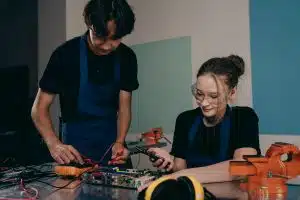
Once at ISEF, students present their research to expert judges, take part in special events, and compete for nearly $9 million in prizes—the largest award pool of any high school STEM competition. Finalists can earn category awards, major scholarships, and prestigious honors.
If you want to know more, check out our blog on the Regeneron ISEF.
3. USA Physics Olympiad (USAPhO)
- Dates: Feb 12, 2026 (F=ma Exam); Late March or Early April 2026 (USAPhO Exam)
- Location: Nationwide
- Prizes: Medals (gold, silver, bronze); Commendation certificates; Invitation to the U.S. Physics Team training camp; Selection for the International Physics Olympiad team
The USA Physics Olympiad (USAPhO) is one of the most challenging physics competitions for high school students. Run by the American Association of Physics Teachers (AAPT), it aims to identify and train the country’s strongest young physicists.
Students who excel at the USAPhO exam may earn a spot in the U.S. Physics Team and eventually compete at the International Physics Olympiad (IPhO), where the U.S. team regularly performs at a world-class level—including winning five gold medals at the 2026 IPhO.
USAPhO challenges students to apply physics concepts at an advanced level, often beyond the typical high school curriculum. Students who reach the USAPhO level may earn gold, silver, or bronze medals as well as commendations for strong performance.
Qualifying begins with the F=ma exam and advances through the USAPhO exam, making it a multi-stage challenge that rewards persistence, skill, and deep understanding of physics. Keep reading about the USA Physics Olympiad on our blog.
4. U.S. National Chemistry Olympiad (USNCO)
- Dates: Feb 27–Mar 16, 2026 (Local Exam); Apr 10–19, 2026 (National Exam)
- Location: Nationwide
- Prizes: Gold, Silver, and Bronze medals; invitations to Study Camp; top four students advance to the International Chemistry Olympiad
The U.S. National Chemistry Olympiad (USNCO) is sponsored by the American Chemical Society and is one of the most respected chemistry competitions for high school students in the country.
The USNCO follows a structured four-tier system that gradually narrows the field. Students begin with the Local Section Exam, where thousands compete for spots at the national level. Around 1,000 high performers advance to the National Exam.

The top 20 scorers earn invitations to the two-week Study Camp, where they receive advanced instruction and compete for a place on the U.S. team. From Study Camp, four students are selected to represent the United States at the International Chemistry Olympiad. Participants can earn certificates, distinctions, medals, and national recognition along the way.
If you want practical advice on getting ready for this competition, check out our complete guide to succeeding in the USNCO.
5. USA Biology Olympiad (USABO)
- Dates: Feb 4, 2026 (Open Exam); Mar 4, 2026 (Semifinal); Jun 21–Jul 2, 2026 (National Finals)
- Location: Nationwide; 2026 National Finals at Harvard University in Cambridge, Massachusetts
- Prizes: Certificates at each exam level; Gold, Silver, and Bronze medals at National Finals; Top students advance to the International Biology Olympiad
The USA Biology Olympiad (USABO) is one of the top biology competitions for high school students who love digging deep into how living systems work.
The competition is run by the Center for Excellence in Education (CEE) and is known for its rigorous exams and high academic standards. Nearly 12,000 students participate each year—and they start with the Open Exam, where high performers earn distinctions before advancing to the Semifinal. From there, 20 finalists will join an intensive residential training program, which will be at Harvard University in 2026.
During the National Finals, you’ll work through advanced lectures, hands-on labs, and problem-solving sessions. Students who earn top medals at Finals may represent the United States at the International Biology Olympiad. Earning a USABO medal also places you among the strongest young biologists in the country.
If you’re thinking about preparing for this competition, we’ve put together a complete guide to USABO that walks you through everything you need to know.
6. USA Computing Olympiad (USACO)
- Dates: Dec 2026 to June 2027 (specific dates vary by session)
- Location: Online
- Prizes: Opportunities to qualify for the U.S. IOI Team, invitations to training camps, national recognition
The USA Computing Olympiad (USACO) is one of the top programming competitions for high school students interested in algorithms, data structures, and problem solving. The contest is held online and features four divisions: Bronze, Silver, Gold, and Platinum.

USACO problems test your ability to think logically and write efficient code using languages like C++, Java, or Python. The contest window stays open for a few days, giving you three to five hours to complete your solutions at your own pace. Students who perform well can earn national recognition and invitations to special training programs.
The biggest reward is the opportunity to qualify for the U.S. team that competes at the International Olympiad in Informatics (IOI), one of the most prestigious global programming contests.
7. North American Computational Linguistics Olympiad (NACLO)
- Dates: Jan 29, 2026 (Open Round); Mar 19, 2026 (Invitational Round)
- Location: Various sites in the U.S. and Canada
- Prizes: Gold, silver, and bronze medals; honorable mentions; team awards; top team trophy; potential qualification for the International Linguistics Olympiad (IOL)
The North American Computational Linguistics Olympiad (NACLO) is a logic-driven contest where you solve real language puzzles using pattern recognition and critical thinking. Instead of memorizing vocabulary or grammar, you look at clues from unfamiliar languages and figure out how they work—almost like decoding a secret message.
NACLO has two rounds each year: the Open Round in January and the Invitational Round in March. You can compete individually or as part of a team, and no prior linguistics experience is required.
Top scorers in the Invitational Round may qualify to represent the United States or Canada at the International Linguistics Olympiad. NACLO offers a variety of awards, from individual medals to team honors, and high-performing students can even earn a spot in the IOL Hall of Fame for earning multiple medals across different years.
If you want to get tips for succeeding in this competition, check out our guide to NACLO.
8. Junior Science and Humanities Symposium (JSHS)
- Dates: Temporarily suspended as of October 2025
- Location: Nationwide
- Prizes: Regional scholarships of $1,000–$2,000; National oral presentation scholarships of $4,000–$12,000; National poster awards of $350–$550
The Junior Science and Humanities Symposium (JSHS) has long been known as one of the nation’s top science competitions for high school students. It gives young scientists a platform to present their original STEM research to expert judges, university partners, and fellow students. Many participants use JSHS to build confidence, get feedback on their work, and explore future pathways in science and engineering.
Sponsored by the U.S. Department of Defense through the Army, Navy, and Air Force, JSHS traditionally hosts regional competitions at universities across the country.

Students compete for scholarships ranging from $1,000 to $2,000 and for the chance to advance to the National Symposium. At the national level, top students present in front of a distinguished panel and can earn even larger awards. Oral presentation winners receive $4,000 to $12,000 in undergraduate scholarships, while poster presenters can earn $350 to $550 based on the strength of their work.
As of October 2025, the JSHS program is temporarily suspended. Students and teachers can contact [email protected] or visit the official website for the latest updates on when future competitions are expected to resume.
If you want updates and preparation tips once the competition returns, read our full guide to the JSHS.
9. Science Olympiad
- Dates: May 22–23, 2026 (National Tournament)
- Location: Regional and state events held nationwide; 2026 Nationals at USC in Los Angeles, California
- Prizes: Founders’ Scholarships up to $10,000 each; SOAR Grants of $25,000 for top researchers and $10,000 for runners-up
The Science Olympiad is a well-known STEM competition where middle and high school students think creatively to apply their classroom lessons in a hands-on setting. With the help of a coach, you and your teammates prepare for events in biology, chemistry, physics, engineering, and more.
Depending on the event, you can expect to design and test devices or focus on lab work, problem-solving, or written exams. The 2026 National Tournament will take place at the University of Southern California (USC), giving qualifying teams the chance to compete on a college campus and meet students from across the country.
The Science Olympiad also offers standout awards. High-achieving seniors can be selected for the $10,000 Founders’ Scholarships, and alumni pursuing research can apply for SOAR Grants, which include two $25,000 awards and two $10,000 runner-up grants.
To participate, you join through your school. Teams must come from the same school administrator and are organized by grade level: Division A for grades K–6, Division B for grades 6–9, and Division C for grades 9–12. Each team may include up to 15 members, with limits on how many students can be in the highest grade.
If you want to learn more about how it works, check out our guide to the Science Olympiad.
10. National Science Bowl
- Dates: Jan–Mar 2026 (Regionals); April 30 – May 4, 2026 (National finals)
- Location: Regionals held nationwide; National Finals in Washington, D.C.
- Prizes: $5,000 for the 1st and 2nd place schools; $1,000 for each of the top 16 schools
The National Science Bowl is one of the fastest-paced STEM competitions in the country. Hosted by the U.S. Department of Energy, it brings middle and high school teams together for buzzer-style rounds that test speed, teamwork, and deep knowledge of science and math. Every team starts at their regional competition, aiming to qualify for the National Finals in Washington, D.C.

During each match, teams race to answer toss-up and bonus questions across biology, chemistry, physics, earth science, energy, and math. Success depends on quick thinking and knowing when to rely on the strengths of your teammates.
Top-performing teams can earn major school prizes, including $5,000 awards for the champions and $1,000 for the top 16 teams. These prizes support their school’s science departments and help strengthen future STEM programs.
If you’d like a deeper breakdown of the rules, scoring, and prep strategies, you can read our blog on the National Science Bowl.
11. Davidson Fellows Scholarship
- Dates: February 11, 2026 (application deadline); May 8, 2026 (decisions are emailed)
- Location: Online
- Prizes: $25,000, $50,000, or $100,000 scholarships
The Davidson Fellows Scholarship is often included among the top science competitions for high school students because it recognizes original work that shows exceptional depth, creativity, and impact that goes far beyond a typical school assignment.
Administered by the Davidson Institute, it recognizes U.S. citizens or permanent residents aged 18 or younger who submit significant projects in math, engineering, literature, philosophy, music, and, of course, science.
Each year, only about 20 students nationwide are named Davidson Fellows, which is one of the highest honors a young innovator can achieve. Although the number of applicants isn’t published, estimates suggest between 500 and 1,000 submissions annually, placing the acceptance rate at just roughly 2 to 4%. Winners receive scholarships worth $25,000, $50,000, or $100,000, making it one of the most generous student awards in the country.
If you want to explore how to strengthen your project or prepare a standout submission, check out our guide to the Davidson Fellows Scholarship.
12. BioGENEius Challenge
- Dates: May 13, 2026 (Application Deadline); May–Jun 2026 (Virtual Rounds); Mid-Sep 2026 (Finalist Competition); Late Oct 2026 (Finals at BioFuture Conference)
- Location: Online rounds; Final Event in New York City
- Prizes: Category awards in Healthcare, Sustainability, and Environment; Overall BioGENEius Award; cash prizes, savings bonds, and exclusive mentorship opportunities
The BioGENEius Challenge is one of the most exciting science competitions for high school students, especially if you’re interested in biotechnology and real-world research.

The program gives you the chance to take an independent research project and present it to scientists, entrepreneurs, and biotech leaders who work on major challenges in health, agriculture, sustainability, and the environment. You’ll begin at your regional level, and if your project impresses the judges, you can advance to the national and international rounds.
The final stage takes place at the BIO International Convention, one of the biggest biotech gatherings in the world. Here, finalists can earn major honors, with the top project receiving the Overall BioGENEius Award.
In addition to these titles, students may also receive cash prizes, savings bonds, and special opportunities like lab tours and meetings with biotech leaders. If you’re curious about how to get started or advance through each round, take a look at our blog on the BioGENEius Challenge.
13. 3M Young Scientist Challenge
- Dates: January 7-April 30, 2026 (Challenge period); June 2026 (Finalists & Merit Winners Announced); October 2026 (Final Event and Announcement of Winners)
- Location: Online submissions; final event in St. Paul, Minnesota
- Prizes: $25,000 grand prize; $1,000 for top 10 finalists; mentorship with a 3M scientist; prize packs and certificates for merit and honorable mention winners
The 3M Young Scientist Challenge isn’t technically one of the science competitions for high school students, since it’s open to grades 5–8. Even though it’s an earlier-level contest, many high school STEM students still follow it because it’s one of the most respected science competitions in the country that offers a great look at how younger students approach innovation.
Run by Discovery Education and 3M, this competition encourages students to solve real-world problems with creative, research-based ideas. To enter, you submit a short video explaining your invention or solution to an everyday challenge. Judges focus on clarity, originality, and scientific thinking (not production value!).
Finalists receive a summer mentorship with a 3M scientist to refine their ideas, then travel to St. Paul for the national finals. There, they present their projects and complete a series of scored challenges that test their scientific reasoning and communication skills. The grand prize winner earns $25,000 and the title “America’s Top Young Scientist,” while other finalists and merit winners receive cash prizes, certificates, and unique STEM opportunities.

If you’d like to explore similar programs or learn how students prepare for major STEM contests, check out our blog on the 3M Young Scientist Challenge.
14. ExploraVision
- Dates: Feb 3, 2026 (Project Deadline); Mar 9, 2026 (Regional Winners); Apr 27, 2026 (National Winners); Jun 3–6, 2026 (Awards Weekend)
- Location: Online submissions; Final event in St. Paul, Minnesota
- Prizes: $25,000 grand prize; $1,000 for each of the top 10 finalists; mentorship with a 3M scientist; prize packs and certificates for state merit and honorable mention winners
ExploraVision is a future-focused science and technology competition organized by Toshiba and the National Science Teachers Association (NSTA) for K–12 students across the U.S. and Canada. Instead of building physical models, you work in teams of two to four and imagine how today’s technology could evolve 20 years from now.
Students compete in grade-based divisions (K–3, 4–6, 7–9, and 10–12) and submit a project that explains the science behind their idea, how the technology might change over time, and a possible prototype sketch. Winning teams earn major prizes, including $10,000 U.S. Savings Bonds for first-place national winners and $5,000 Bonds for second-place teams. Regional winners, honorable mentions, and teachers also receive recognition and awards.
National winners travel to Washington, D.C. for the ExploraVision Awards Weekend, where projects are showcased through hands-on events and media features.
If you’d like a closer look at how students prepare strong entries, check out our complete guide to ExploraVision.
15. MIT THINK Scholars Program
- Dates: Jan 1, 2026 (Applications Due); Jan 30, 2026 (Semifinalists); Feb 2026 (Finalists); Feb–Spring 2026 (Finalist Program)
- Location: Online program with finalists visiting MIT in Cambridge, Massachusetts
- Prizes: Mentorship from MIT researchers, project funding, campus visit, lab tours, and THINK Scholars designation upon project completion
The MIT THINK Scholars Program is different from most science competitions for high school students because you don’t need a finished research project to apply. Instead, you submit a research proposal that outlines a creative idea in science, technology, or engineering.
If your proposal stands out, you’ll become a finalist and receive guidance from MIT mentors who help you shape your idea into a full project. This approach makes THINK a great fit if you’re full of ideas but still figuring out how to turn them into real research.

Finalists travel to MIT for an all-expenses-paid visit, where they tour labs, meet professors and current students, and get a deeper look into MIT’s research culture. Throughout the spring, you’ll work on your project with support from the THINK team until the final presentation in June.
Those who successfully complete the program earn the title of MIT THINK Scholar.
16. eCYBERMISSION
- Dates: Mar 4, 2026 (Mission Folder Deadline); Mar 11–25, 2026 (Virtual Judging); Apr 20–24, 2026 (Regional Judging); May 1, 2026 (Winners Announced); Jun 22–26, 2026 (National Event)
- Location: Online; National Judging and Educational Event held in-person (location varies each year)
- Prizes: Savings bonds, state and regional awards, national recognition, and an invitation to the National Judging and Educational Event for top teams
eCYBERMISSION is one of the most accessible science competitions for high school students in the lower grades, especially those in grades 6 through 9 who want a free, online STEM challenge. Sponsored by the U.S. Army, the competition asks student teams to investigate a real community problem using science or engineering.
Instead of a traditional science fair model, eCYBERMISSION focuses on practical problem-solving and community impact, helping younger students understand how STEM can make a real difference.
Teams of two to four students work with an adult Team Advisor to research a problem, conduct experiments or build solutions, and submit their findings in a Mission Folder. The competition offers both virtual and in-person opportunities.
Top-ranking teams receive savings bonds, state and regional awards, and the opportunity to attend the National Judging and Educational Event. These honors help students build early confidence in STEM and set a strong foundation for future competitions and advanced high school science opportunities.
Frequently Asked Questions
1. How do I choose the right science competition for me?
To choose the right science competition, start by thinking about what subjects you enjoy most and how much time you can commit. Some contests focus on research, while others are team-based or problem-solving events. Pick a competition that matches your strengths and interests.
2. Are science competitions expensive to join?
Most national contests are free to enter, especially those sponsored by universities or government organizations. Some require travel for finals, but many offer virtual rounds or financial support to help students participate.
3. Can entering science competitions help with college applications?
Yes, entering science competitions helps with college applications! Colleges appreciate students who take initiative, challenge themselves, and pursue academic interests outside the classroom. Winning awards isn’t required, but simply participating can show curiosity and commitment to learning.
4. Do I need a completed research project to join science competitions?
You don’t always need a completed research project to join science competitions. Some competitions, like ISEF or STS, require full high school research projects, but others focus on exams, teamwork, design challenges, or proposals. You can start with events that match your current experience level.
5. What if I’m new to STEM? Can I still join?
Absolutely, you can still join even if you’re new to STEM. Many science competitions for high school students welcome beginners and offer entry-level categories. Joining early helps you build confidence and gain experience for larger science competitions later on.
Takeaways
- Science competitions for high school students help you build deeper STEM skills, from problem-solving and research to teamwork and communication.
- Prestigious contests such as Regeneron STS, ISEF, Science Olympiad, and the National Science Bowl open doors to scholarships, national awards, and recognition that strengthens your college applications.
- Most competitions require dedication, practice, and strong project planning, whether you’re writing a proposal, conducting experiments, or training for exams.
- If you want personalized help choosing the right competitions or improving your application, work with an admissions expert who understands STEM pathways.










