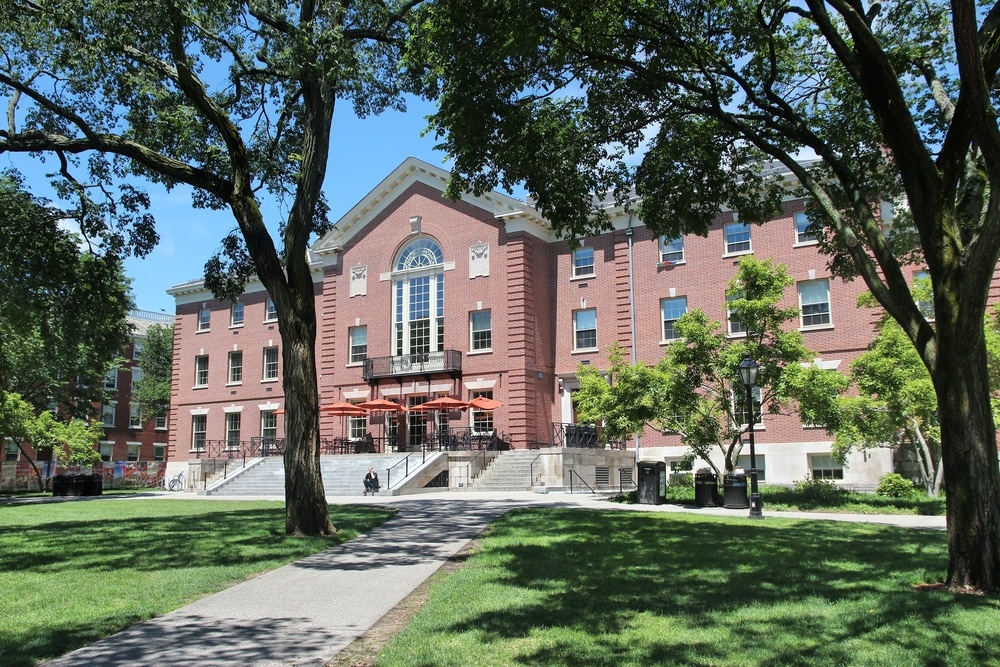
Brown University recently climbed to the 9th spot in the U.S. News & World Report’s 2024 Best National University Rankings—its highest rank in over two decades. It’s no wonder why top students from around the world are drawn to this Ivy League school.
With its prestigious Ivy League status, the flexibility of its Open Curriculum, dynamic campus life, and strong career prospects for graduates, Brown has much to offer. In this blog, we’ll talk about all the reasons why you should consider attending Brown.
- Reason 1: Brown University’s Ivy League Status
- Reason 2: Brown University’s National and Global Rankings
- Reason 3: Brown University’s Faculty and Research
- Reason 4: Brown University’s Open Curriculum
- Reason 5: Brown University’s Campus Life
- Reason 6: Brown University’s Career Outcomes
- How to Get into Brown
- Frequently Asked Questions
- Takeaways
Reason 1: Brown University’s Ivy League Status
Brown University is part of the Ivy League, a group of eight of the most respected universities in the U.S. Founded in 1764, Brown is one of the oldest in the league. Its Ivy League label significantly boosts the value of a Brown degree in the eyes of employers and grad schools around the world.
One major perk of attending an Ivy League school like Brown is the access to a powerful alumni network. Brown grads often hold influential positions across various fields, and they’re known for helping out fellow alums. If you’re eyeing an internship or your first job, these connections can give you a real edge early in your career. Who you know can be just as important as what you know.
Statistically speaking, Ivy League graduates tend to earn more in their early and mid-careers compared to those from other schools. The median early career pay for Ivy League grads is around $87,000, which is 71% higher than the national average of $50,806. That’s a pretty solid financial advantage, on top of the prestige that comes with an Ivy League education, opening doors that might be harder to access otherwise.
Beyond the numbers, Brown is an ideal place for anyone serious about their education. Being at Brown means you’re surrounded by some of the brightest and most driven students of your generation, creating an environment buzzing with intellectual curiosity and achievement.
Reason 2: Brown University’s National and Global Rankings
Another reason why Brown University should be on your radar is its impressive performance in both national and global rankings.

In its 2024 U.S. News & World Report rankings, Brown hit a major milestone by securing the 9th spot among national universities, tied with Johns Hopkins and Northwestern. This is Brown’s highest position since 1997.
The recent changes in ranking methodologies, which now give more weight to factors like student-faculty ratios and graduation rates for first-generation students, have highlighted what Brown has always excelled at: providing a high-quality, inclusive education.
According to the same source, Brown is also:
- #1 in Writing in the Disciplines
- #3 in Best Undergraduate Teaching
- #5 in Senior Capstone
- #8 in First-Year Experiences
- #10 in Service Learning
- #11 in Best Value Schools
- #11 in Economics
- #17 in Undergraduate Research/Creative Projects
- #37 in Best Undergraduate Engineering Programs
- #54 in Best Colleges for Veterans
Globally, Brown continues to shine. It ranks 79th in the QS World University Rankings, proving its global influence in both research and education. What’s more, Brown is ranked 25th globally for graduate employability. This shows how well Brown prepares students for successful careers after graduation.
Reason 3: Brown University’s Faculty and Research
One of the most compelling reasons to choose Brown University is the exceptional quality and accessibility of its faculty. At Brown, you’re learning from leaders in their fields. This means you’ll have the chance to collaborate with experts who are at the cutting edge of their disciplines.
Take Jesse Shapiro, for instance—one of Brown’s 17 MacArthur “Genius Grant” recipients. Shapiro is known for his innovative work in economics and social issues. Moreover, Brown’s roster of past and present professors includes seven Nobel laureates:
- Lars Onsager for Chemistry (1968)
- Leon Cooper for Physics (1972)
- George Snell for Physiology or Medicine (1980)
- George Stigler for Economic Sciences (1982)
- Henry David Abraham for Peace (1985)
- Vernon L. Smith for Economic Sciences (2002)
- J. Michael Kosterlitz for Physics (2016)
Brown’s faculty members are actively involved in groundbreaking research, and they make it a point to include undergraduates in meaningful projects. For example, Brown’s FY24 budget highlights a significant $25 million investment in research. These funds will go towards building new research spaces, getting advanced equipment, and bringing in high-profile tenure-track faculty across various fields, from the arts to the sciences.
Reason 4: Brown University’s Open Curriculum
Brown University’s Open Curriculum is one of the most distinctive features that sets it apart from other Ivy League schools. Unlike the traditional academic programs, Brown’s approach ditches the usual core requirements, handing you the reins to your education. This means you get to choose courses that genuinely interest you and align with your career goals.
The Open Curriculum is built around three key principles:
- You take an active role in designing your education.
- You focus on both intellectual and personal growth.
- You’re encouraged to explore interdisciplinary studies.
With over 80 concentrations to choose from, you’re not stuck following a rigid set of general education courses. Instead, you can mix and match fields in ways that might surprise you.

Imagine pairing computer science with visual arts, leading to projects that merge AI with creative design. Combining theater arts with psychology? Environmental studies with public health? The Open Curriculum gives you the freedom to innovate and explore.
The curriculum also creates a collaborative environment. Brown’s grading system is pretty unique—offering the choice between traditional letter grades or a satisfactory/no credit option. This takes the pressure off and lets you survey new and challenging subjects without worrying about tanking your GPA. It’s all learning for the sake of learning.
In short, the Open Curriculum is a big reason why Brown attracts independent thinkers and self-starters. It offers a level of academic freedom that’s hard to find anywhere else. Brown encourages you to chase your passions and prepares you for a future where thinking across disciplines is a major asset.
Reason 5: Brown University’s Campus Life
Brown University is known for its welcoming and inclusive and diverse community, bringing together students from all 50 states and over 100 countries.
Brown ranks 3rd out of 2,183 institutions for geographic diversity. With about 95% of students coming from out of state and over 14% being international, you’re guaranteed to meet people from all walks of life and encounter a broad mix of perspectives and ideas.
What really brings the campus to life, though, are the student organizations. Brown has over 500 recognized student groups that cover everything from politics and arts to community service and entrepreneurship. These organizations give you plenty of opportunities to develop leadership skills, connect with others who share your passions, and make a real impact on campus. If you don’t find a club that speaks to your interests, you’re free to start your own.
Brown also backs up its commitment to diversity with strong support systems:
- Centers like the First-Generation College and Low-Income Student Center (U-FLi Center) and the Brown Center for Students of Color offer crucial spaces where students can connect and feel at home.
- The Swearer Center for Public Service links students with over 80 community organizations, promoting community engagement and social innovation as core parts of the Brown experience.
With its diverse student body, countless student organizations, and strong support services, Brown provides an environment where you can truly thrive—academically, socially, and personally.
Reason 6: Brown University’s Career Outcomes
One of the smartest reasons to consider Brown University is the impressive career outcomes its graduates enjoy. A big part of this success comes from Brown’s Center for Career Exploration (formerly CareerLAB). This center helps students make the leap from college to career. Whether you need career counseling, help finding internships, or connections through Brown’s extensive alumni network, they’ve got you covered.
According to the data provided by the center, for the Classes 2017 to 2021, a solid 76% of Brown University graduates landed jobs immediately after graduation. Meanwhile, 24% went on to grad school or professional studies.
The starting salary for these new professionals is about $60,000, but that number can climb to around $87,000 a decade later.
The university’s strong focus on experiential learning—think internships, research projects, and community involvement—means you’ll graduate not just with knowledge, but with real-world skills and experiences that employers and grad schools value.

How to Get into Brown
The first thing you need to know is that getting into Brown University is tough. For the Class of 2028, for example, Brown’s acceptance rate was a slim 5.2%, one of the lowest they’ve ever had. Out of over 48,000 applicants, only about 2,500 got in. This tight acceptance rate highlights just how selective Brown is and why it attracts so many eager students each year.
Admissions criteria
Brown doesn’t have a strict GPA or class rank cutoff. Instead, they’re interested in students who’ve tackled challenging courses and made the most of their academic opportunities.
When submitting standardized test scores, know that the middle 50% of admitted students scored between 1510 and 1570 on the SAT or between 34 and 36 on the ACT.
But academics aren’t the only thing on Brown’s radar. They also place a lot of weight on extracurricular activities. Brown University is looking for students who are passionate about learning, curious, and dedicated to making a positive impact in their communities.
As part of your application, you’ll also need to provide:
- Recommendation letters. Two teacher recommendations that shed light on your academic abilities and personal qualities, and a counselor recommendation.
- Essays. These include the Common Application essay and three supplemental ones that explore your academic interests, community involvement, and perspectives on diversity.
In the end, the admissions process at Brown University is all about finding students who will thrive in their open, intellectually stimulating, and diverse environment. If you’re asking why Brown University is so competitive, it’s because they seek well-rounded individuals who will bring something unique to their campus.
Frequently Asked Questions
1. Is Brown University a good school?
Brown University is top-tier, no question. Brown’s consistently high rankings, both nationally and internationally, reflect its solid academic programs, research opportunities, and the lively campus life that comes with being part of this prestigious institution.
2. Is Brown an Ivy League?
Yes, Brown is part of the Ivy League. It is a group of eight prestigious private colleges in the northeastern U.S., known for their academic rigor and rich history. Being in the Ivy League adds serious value to your degree and opens doors to a powerful alumni network and tons of career opportunities.
3. What is Brown’s acceptance rate?
For the Class of 2028, Brown’s acceptance rate was a slim 5.2%, making it one of the most selective schools in the U.S. This low figure reflects Brown’s commitment to enrolling students who have not only exceptional academic records but also impressive extracurricular achievements.
4. What is Brown University known for?
Brown is best known for its Open Curriculum, which lets you design your academic path without the usual core requirements. Brown also shines in areas like economics, computer science, and the humanities. Beyond academics, it’s a place where campus life thrives, diversity is celebrated, and there’s a strong commitment to social justice and community engagement.
5. Is Brown University an HBCU?
No, Brown isn’t a Historically Black College or University (HBCU). While it’s a diverse institution, HBCUs are specifically colleges and universities that were established primarily to serve the African American community. Brown, while inclusive, isn’t classified as one of these institutions.

Takeaways
Here are five key takeaways on why you should consider Brown University:
- Brown’s Ivy League status provides prestige and access to an alumni network stacked with leaders in industries like finance, technology, and government.
- Brown’s Open Curriculum lets you break free from the usual core requirements. You get to craft your own course of study that truly matches your passions and goals.
- Seven Nobel laureates and 17 MacArthur Fellows have been on Brown’s faculty. At Brown, you’ll be mentored by some of the brightest minds around.
- Brown’s student body is as diverse as it is engaging. With over 500 student organizations and countless cultural events, you’ll find plenty of ways to grow both personally and socially.
- Brown’s acceptance rate is only 5.2%. But with the right guidance from a college admissions consultant, you can boost your chances of landing a spot at this prestigious university.